Mass Notification Buyer's Guide
15 questions to ask vendors when selecting a mass notification system.

15 questions to ask vendors when selecting a mass notification system Mass notification buyer’s guide
White paper
Overview Whether you’re a private, public, or government organization, more than anything, you want to keep your people safe from harm’s way. For any event— whether it’s day-to-day communications or major incidents—you want to ensure your critical communications and messages are effective and quick enough to accomplish successful event resolutions.
Both global and domestic threats to employee safety are on the rise, and an unprecedented increase of people working remotely has changed the entire security landscape. Traditional emergency notification solutions that were designed for a different era fundamentally fail to keep up with today’s dynamic mobile and remote workforce. Today’s threats require a location-aware approach to physical security. You need to be able to reach and communicate with all of your contacts wherever they are in the world.
The key to improving communication through a mass notification system is selecting the right one, but with all the vendors out there—and with all the noise created by sales pitches—it can be a daunting and tiresome task. Yet by asking the right questions, you can weed out many options and uncover the one that’s truly the best fit for your organization now and in the future.
Today’s threats require a location-aware approach to physical security. You need to be able to reach and communicate with all of your contacts wherever they are in the world.
Choosing the right mass notification system vendor is one of the most important decisions you can make when it comes to the safety, security, and future of your organization.
© 2023 Everbridge | everbridge.com 2
White paper15 questions to ask vendors when selecting a mass notification system
So, where do you begin? Read on to learn the 15 most critical questions you need to ask any prospective vendor before selecting your mass notification system.
1. How will the system be configured to your internal organizational structure?
Your prospective vendors need to be able to mimic how your organization is set up. Inside the system, an administrator should be able to collect and set up data groups based off various factors which include but aren’t limited to, department, skillset, and job description. Additionally, the administrator should have the ability to set controls for various groups so unintentional messages aren’t sent to the wrong people. The system should have a streamlined, one-page notification process with one-click sending. This can not only save time, but in a real emergency, possibly save lives.
2. Can the system adapt to your data management needs?
A system is only as good as the data it possesses. The higher the quality, the more likely a broadcast will reach its targeted recipients, thus increasing the chance of a successful response and recovery of an event. When selecting a vendor to provide a critical communication system you must consider how your data is managed. Different systems can offer varying data collection management processes. While some methods are more reliable than others, in the end, the more options available the better.
Traditional approaches, such as manual entries are a must, especially for singular edits. Other methods that should be available that can be controlled
by your system administrator are integration with your HR database to automatically and continually push singular updates. For example, if an employee changes their mobile phone number at 3:00 PM on Friday, then the client connector can push the update to their database at 3:01 PM. Additionally, it is vital to allow your members to subscribe themselves, whether employees, stakeholders, executives, or residents. This method can dramatically increase the amount of contact paths that are provided and any special requirements for messaging.
3. Can the system be accessed by a mobile device from any location?
These days, people work everywhere—not just from traditional office buildings and headquarters. Even at the government level, people are not always working in centralized or static locations, which creates a need for a system that is available anytime, anywhere.
It is important to have the ability to quickly log on and send a message via a mobile device. Additionally, those who might be on scene or in the area should have the ability to send and receive messages from any location when broadcasts go out. This can help with response efforts since the people “on the ground” can provide valuable feedback and updates. Administrators can even send continuous updates and instructions when needed, ensuring recovery efforts are successful.
© 2023 Everbridge | everbridge.com 3
White paper15 questions to ask vendors when selecting a mass notification system
4. How does the vendor help you successfully communicate with your contacts on any device?
No one answers their messages the same way. Moreover, depending on the time of day, people will answer or receive a message differently. Companies need instant access to determine who is affected by an incident, and can’t be fumbling through multiple software tools and consolidating manual responses. These dated solutions are typically limited to targeting people based on static locations—groups typically based on work location, or in some cases home addresses, as we’ve discussed above. This doesn’t help solve the problems of workforce accountability with a dynamic workforce.
With the ability to combine information about employees’ static addresses (e.g. home/work address) and information about their last known and expected locations, your provider should have the capabilities to provide customers with a single pane of glass view of their employees in relation to active, developing, or potential threats.
5. Does the system provide 2-way communication capabilities as well as confirmation that messages are successfully received?
When an incident strikes, you need to send information to the appropriate staff. When looking into vendors, make sure they offer multi- modal messaging with as many contact paths as possible. Those should include, voice, SMS, push notifications and email, among many more. Just as important, in the middle of an incident, you can’t be worrying about whether your messages have reached all your contacts or not, nor do you have time to field complaints that they did not receive an alert at all.
Your system needs to provide two-way communication so staff can either confirm, ask for more information, or provide additional information. As events progress, it is helpful to provide further instructions as well as having two-way updates come from the department and the field. For departments that are required to reach out to residents, message confirmation with two-way communication is extremely vital. For events that
The system must be intuitive and simple when evaluated by the people who will be using it on an intermittent or day-to-day basis. Ask each potential vendor if their system can:
• Manage settings, limits, and defaults through a comprehensive and user-friendly administrator interface?
• Import, organize, and categorize contact data in a way that is meaningful to your organization?
• Easily automate bulk, partial, and full updates utilizing a secure, industry standard method for data transfer?
• Define role-based access controls for managing separate user and contact data?
• Easily notify contacts and/or manage contact data across multiple distributed data stores and groups from a single access point?
• Include multiple groups and custom fields from internal systems to help with message targeting?
• Set opt-in portals to either publicly available or private (invitation only) and allow contacts to opt- in, update, and manage their accounts—including contact information, locations they care about, alert preferences and more—through branded, customizable web-based portals?
• Support public and private accessibility guidelines for portals which are Section 508 compliant and include field-level view/read/write access controls?
© 2023 Everbridge | everbridge.com 4
White paper15 questions to ask vendors when selecting a mass notification system
require a response, such as an emergency or a request to cover a shift, a system needs to be able to have its recipients confirm messaging, and in some instances, reply with messages.
For emergencies, messages should require confirmation and a response, like “Do you need help?”, “Press 1 for Yes, Press 2 for No”. This functionality can help your department know who needs assistance, allowing you to divvy up response efforts appropriately. Additionally, if your tool supports two-way communication, your residents or customers could act as your “eyes and ears” on the ground sending relevant updates or even making you aware of an incident. Ultimately, this could lessen the overall impact of an event.
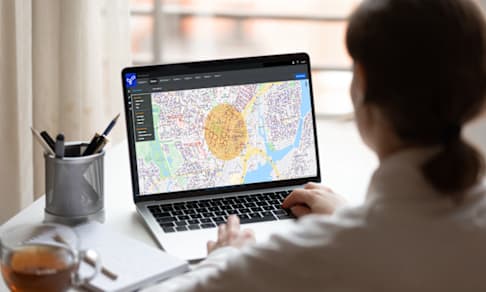
6. Is the system geo-intelligent with GIS-based message targeting?
During the selection process or a notification system, it is important to discuss mapping functionality. GIS (Geographic Information System) mapping capabilities can help with response efforts, sending location-based messaging, and more.
Mapping helps you ensure you know who is in a particular area to send the appropriate messaging based off their exact location. In some cases, this could be the difference between life and death.
Ask any prospective vendor the following question. Can the system:
• Send messages to recipients in a specific geographic region?
• Specify target locations with user friendly drawing tools, or even upload shape files?
• Search for, view the locations of, and send alerts to specific contact types?
• Highlight functional needs populations, fire districts, alert type subscribers, and more?
• Load, geo-code, and manage contact data within a single interface and in real-time?
7. Can the system publish messages to social media sites?
Having a notification system with the ability to publish messages directly to your department or organization’s Facebook and Twitter accounts is very important. Not only will this save time during an emergency situation if you need to just blast a message, but will also widen the reach of your message. Social media is an extremely valuable community engagement tool and is a main channel for residents to receive information from law enforcement and local public safety.
Integrating messages from your notification system with social media will increase the value of your system and messages. Additionally, for businesses this can provide another avenue to share important updates, service advisories, and more. This will further build relationships your organization has with its customers and stakeholders. For state and local governments, it’s important that the system be able to push notifications onto their website for free.
Now it’s more important than ever that you’re reaching the person, not the device, as we become more and more decentralized.
© 2023 Everbridge | everbridge.com 5
White paper15 questions to ask vendors when selecting a mass notification system
8. Is the notification process streamlined in order to help eliminate human error?
Both minor day-to-day incidents and major emergencies can happen at any frequency. During these situations, system users who are responsible for notifying citizens or other staff are under a significant amount of pressure. This can increase errors like missing information, sending the wrong message, or not sending a message at all. However, there are measures you can take to be better prepared for any situation. The key is having a vendor that can provide you with the tools necessary to create and execute those plans. That is why it is important when selecting a system to verify that you have the ability to create incident templates.
Incident templates can be a key to increasing overall success of an event. Templates allow you to reduce the number of actions and variables that go into a message broadcast. The reason this is important is it helps automate specified steps— when time is most valuable—and reduce the risk of human error.
Certain aspects that incident templates should include are:
• The critical information being sent
• The message or messages that will be sent (this can include instructions and scheduled updates throughout the broadcasts)
• The parties that will receive message (you can have different messages going to different groups)
• The way end users receive messages (on what device and contact path)
• The frequency at which the broadcast is delivered. The more variables you have
predetermined in your broadcast the less likely the quality of the message will be affected— meaning the more likely it will be delivered to the right people, with the right message, at the right time
9. Does the system provide a simple, intuitive user experience?
A mass communication system must be easy to use. But ease of use is difficult to fully quantify because “easy” is often a personal opinion based on an individual’s capacity to assimilate technology. Additionally, every vendor will claim its system is the easiest to use, which adds to the confusion.
So, if all of the systems are easy to use, should “ease of use” really be a primary factor in the final purchasing decision? Yes—given the critical nature of a notification system, user friendliness is important. In fact, high levels of stress can reduce a person’s cognitive capabilities during a crisis; for example, a system that seemed easy to use in a practice situation may seem overly complex when a person is under pressure during an emergency.
To help strip away some of the subjectivity of ease of use, measure this attribute on a set of standard criteria. In times of crisis, you need simple, intuitive interfaces. When considering any critical communication system, determine whether the average employee will be able to use the system with little to no training, or if the system will require some type of specialist. Many of the systems on the market today are flashy, but also primarily focused towards a highly technical user. While this type of system can be very impressive during a vendor-led product demonstration, in an emergency, the user can quickly get lost within the menus.
© 2023 Everbridge | everbridge.com 6
White paper15 questions to ask vendors when selecting a mass notification system
10. Does the system have reporting functionality? Ask your vendor what reporting tools the system uses. Any event, whether large or small, can provide valuable information and insight into how your team performed. Did your messages go out on time? Were your messages received by everyone? Additionally, it can expose the quality of data that is being used for broadcasts. The system should be able to measure your communication program’s effectiveness and continually improve its efficiency with robust analytics and reporting capabilities.
When a notification goes out, would it help your organization to see real-time data? Consider that no two events are exactly the same for any organization—you need to alter the way you communicate depending on the situation. Organizations need a powerful and accurate incident analyses in real-time, so you can make quick changes in your communications strategy to improve outcomes.
Moreover, you need to have the ability to create reports for management in case approval is needed for any type of changes or alterations. Every event’s communication strategy—even those well planned for—has its areas that didn’t perform in the most effective way possible. You need to know what the response rates were, who was and wasn’t reached, were there any failed messages, and if so, why.
Administrators can even send continuous updates and instructions when needed, ensuring recovery efforts are successful.
© 2023 Everbridge | everbridge.com 7
White paper15 questions to ask vendors when selecting a mass notification system
Your organization needs to uncover those areas with detailed notification analysis reports. This will provide better after-action reviews, continuous improvements, and regulatory compliance. For government agencies, in addition to having basic reporting functionally, your notification system should be able to easily archive your emergency notification messages, Facebook posts, and tweets to respond to Freedom of Information Acts requests for community notices.
Ask any prospective vendor these additional questions when it comes to reporting. Can the system:
• Adapt to quick changes after accurate incident analyses in real-time?
• Quickly launch frequently requested reports via an intuitive dashboard?
• Provide summary and detailed notification analysis (DNA) reports for better after-action reviews, continuous improvements, and regulatory compliance?
• Easily enhance exported reports with offline creation of pivot tables and cross-referencing?
11. Is the system scalable? A scalable system enables your organization to be stable and productive in any situation, no matter what is happening. Frequently, organizations considering critical communication solutions are thinking about either routine, operational incidents, or major, disruptive events—but not both at the same time. A system with the flexibility to support both incidents and emergencies can provide value for your organization, as well as improve your operational response. A critical communication system that automates multiple communication processes and procedures reduces human error, improves efficiency, creates familiarity with the system, and lowers your organization’s exposure to risk. Determine whether a vendor’s system is
capable of scaling from routine incidents to major emergencies.
What’s the difference between incidents and emergencies? Emergencies tend to be lower frequency events, requiring agility and process flexibility, as response processes for emergencies may be very different for similar events. Emergencies also tend to be harder to predict. Incidents, on the other hand, are high frequency and mostly predictable events. Incident management typically relies on run books or pre- determined processes, and is more frequently documented for compliance. Incident management cannot be customized on the fly for users, as it is critical to follow correct procedures based on specific incident types. Critical communication around incidents is focused on notifying and tracking the response team needed to respond to and repair an incident. Be sure to have the vendor show you how their mass notification system scales between routine incidents to major emergencies.
© 2023 Everbridge | everbridge.com 8
White paper15 questions to ask vendors when selecting a mass notification system
12. Is the system secure? Make sure the vendor is committed to providing you a secure environment with state-of-the-art technologies to safeguard your information. The vendor should help you comply with all local and global regulations while also protecting the privacy of your employees.
To the right is a cheat-sheet of the minimum certifications and compliances a vendor should have.
13. How can you ensure the vendor’s resilience? A critical communication system is only useful if it is working properly. Unfortunately, there are numerous factors that can affect its performance, including human-induced events and natural disasters. What would happen if you couldn’t reach the people you needed to in an emergency? This is why it is so important that you have a resilient system.
While some parts of the world or even specific regions might be less prone to an event, in a moment’s notice, an emergency could happen. What if the event knocks out the data center?
Your provider cannot be crippled by this or it will ultimately affect you. To ensure uptime, your system has to guarantee a few things.
First, the provider has to have multiple data centers in case one should fail. Second, they need to have centers that are geo-dispersed, ensuring if a localized event happens, only that one center is affected. When asking a provider if the system they provide is resilient, it is also important to understand how that connects with scalability. If a system is pushed to its limits because of extremely high usage caused by an emergency event and fails, it is not resilient. An emergency notification system has to be able to harness the cloud for additional data centers—located in different areas, unaffected by an event—for additional capacity and as a failover if one or all of a provider’s systems should be down.
Any number of incidents can happen, which in turn can cause issues within a system. However, if a system is constantly being monitored, your vendor can catch potential issues before there are problems affecting the end user. This monitoring should include every aspect of the tool, from texting capabilities to response rates.
Global Certifications: • ISO 27001:2013
• ISO 27701
• SSAE-18 SOC 3
US Government Certifications: • Safety Act
• FedRAMP
EU Privacy and Compliance:
• GDPR
• BSI C5
• Privacy Shield
UK Government Listings: • G-Cloud
• UK ICO
© 2023 Everbridge | everbridge.com 9
White paper15 questions to ask vendors when selecting a mass notification system
Resilience extends beyond data centers. What happens when your application may be functioning perfectly, but your third-party providers are affected by a regional incident? To this end, your mass notification system should include multiple channels into every delivery path. For example:
• Multiple telecommunications vendors for sending voice notification
• Multiple SMS gateways
• Multiple FAX gateways or vendors
The system also needs to be able to support an increase in the number of your users who log in to perform critical tasks. During the start of an incident, for example, typically more users are called to action and need to connect to the service concurrently.
14. Will your vendor provide industry thought leadership?
A vendor’s reputation says a lot about their ability to fulfill your organization’s communication and critical event management needs. Look for third party validation from respected industry analysts, such as Gartner and Forrester. These analysts spend significant time and effort evaluating vendors’ current offerings, as well as their future visions. Research the vendor’s history to see what awards they’ve won and what other recognition they’ve received. Find out how many existing customers the vendor currently serves and whether those customers themselves are thought leaders in their respective industries.
A vendor who is an industry leader educates the market and creates a dialog with users. This can include hosting educational webinars, providing informational resources on industry topics and current events, participating in respected trade shows and hosting conferences and events to encourage direct feedback from users. A
repudiable vendor doesn’t just react to industry advances, but molds and shapes the industry with progressive thinking, innovative solutions, and participation in interactive community events and forums.
Evaluate the provider’s willingness to help you analyze your business challenges and solve problems, beyond trying to sell you their solution. Vendors who look at mass notification as a side business or even standalone business are often unable to provide the attention, investment or customer service needed to fully support your needs, and stifle the ability to grow with them over time. Remember that great providers are problem solvers, but will walk away from an opportunity if their solution is not the right fit.
15. Will your vendor carry you into your future?
How likely is your organization to change and mature over time? Will you want the option to build on your mass notification capabilities in the future? If this is the case, then you’ll need a vendor who offers more than just a single product with no additional ways to expand functionality. Instead, you want a vendor who offers multiple applications. That way, you only have to access one platform without the additional cost of integrating multiple solutions.
Perhaps you’d like to add other automation and workflows with templates and rules that can be created for many different scenarios. How about initiating chat features with all your responders in the field? How important might video capabilities be with incident chat? Would you need to download the chat record log for auditing/public records’ request?
In order to move to an even more comprehensive approach to managing critical events as your
© 2023 Everbridge | everbridge.com 10
White paper15 questions to ask vendors when selecting a mass notification system
organization changes or grows, you may want to add enhanced risk intelligence and situational awareness for proactively monitoring other threats that might occur. This proactive monitoring of threats to people, processes, and assets can enable your organization to build on your mass notification capabilities and move from reactive to proactive when it comes to mitigating risk.
The bottom line is, a vendor who provides just mass notification capabilities may not be able to help you with full critical event management over time. Perhaps a mass notification system meets your needs now, or perhaps you may never need more than a mass notification system. But it’s good to know that you have options if your needs expand over time.
Conclusion In conclusion, selecting the right mass notification system vendor is a crucial decision that organizations must make to ensure safety, security, and effective communication in times of emergencies and critical events. By considering these 15 essential quexsstions and evaluating vendors based on their responses, organizations can make an informed decision and choose a system that aligns with their internal structure, data management needs, communication requirements, and scalability goals.
Remember that organizations should select a mass notification system that not only meets
their current needs but also provides flexibility, reliability, and adaptability for future requirements. With the right mass notification system in place, organizations can enhance their emergency preparedness, improve response times, and ultimately ensure the safety and well-being of their employees, stakeholders, and communities.
As an industry-leading expert in mass notification technology for over twenty years, Everbridge can provide all the help your organization will need in determining the right solution for your unique environment.
© 2023 Everbridge | everbridge.com 11
White paper15 questions to ask vendors when selecting a mass notification system
About Everbridge
Get in touch to learn about Everbridge, empowering resilience.
BO-WP-EN-15 questions to ask vendors_07.27.23
About Everbridge Everbridge, Inc. (NASDAQ: EVBG) empowers enterprises and government organizations to anticipate, mitigate, respond to, and recover stronger from critical events. In today’s unpredictable world, resilient organizations minimize impact to people and operations, absorb stress, and return to productivity faster when deploying critical event management (CEM) technology. Everbridge digitizes organizational resilience by combining intelligent automation with the industry’s most comprehensive risk data to Keep People Safe and Organizations Running™.
For more information, visit Everbridge.com, read the company blog, and follow us on LinkedIn and Twitter.